0%
 

WELCOME

COURSE NAVIGATION TIPS

The Home button at the end of each topic takes you to the Home page.

The Menu button provides access to the individual topics.

The Resources button provides a list of useful links.

The Close button ends your training session and closes the course window.

The Switch Language button allows you to change the chosen language the course is presented in.

Videos in this course are accompanied by audio, so have your headphones ready or adjust your volume.


LEARNING OBJECTIVES

This course has been created to help individual contributors within PIF understand objective setting and the balanced scorecard process.

This course will help you:

  • Understand the importance of aligning individual objectives and KPIs with organizational goals.
  • Learn the process of setting SMART objectives collaboratively with People Managers.
  • Gain insights into the key considerations for cascading individual objectives.
  • Understand the linkage and cascade between Corporate Performance Management and Individual Performance Management.
  • Understand the roles of various stakeholders in setting objectives and KPIs.

COMING NEXT

In our next topic, we will start to explore the strategy cascading framework project and understand how it supports PIF activities.

PERFORMANCE MANAGEMENT AND STRATEGY CASCADING AT PIF

PURPOSE OF THE STRATEGY CASCADING FRAMEWORK

Strategy, accountability and transparency are the three pillars that the strategy cascading framework supports. By bringing these pillars together, the project helps to support wider PIF activities.

Select each image to find out more.

Strategy
 

Translate strategy into action, through cascading PIF Objectives and KPIs into Divisional KPIs and Initiatives to support and assist in allocating and prioritizing resources.

Accountability
 

Clarify accountability and ownership and increase employee engagement.

Transparency
 

Create greater transparency and enable performance results to PIF leadership to allow decision making.

HOW INDIVIDUAL OBJECTIVES ARE DETERMINED

To understand how the cascading framework can help your team, we are going to look at how the PIF vision translates into division and individual objectives.

Select the Play button to learn more.

Once the video has completed, use the tab key to navigate to the next item.

 

KNOWLEDGE CHECK

Which of the following phrases describe the purpose of the strategy cascading framework?

Select the options you think are correct and then select Submit.

COMING NEXT

We have now explored cascading objectives and how they ensure performance metrics are aligned. In our next topic, we are going to examine employee scorecards as these provide the framework for measuring and tracking performance.

INPUT FOR EMPLOYEE SCORECARDS

SOURCES OF DATA FOR EMPLOYEE SCORECARDS


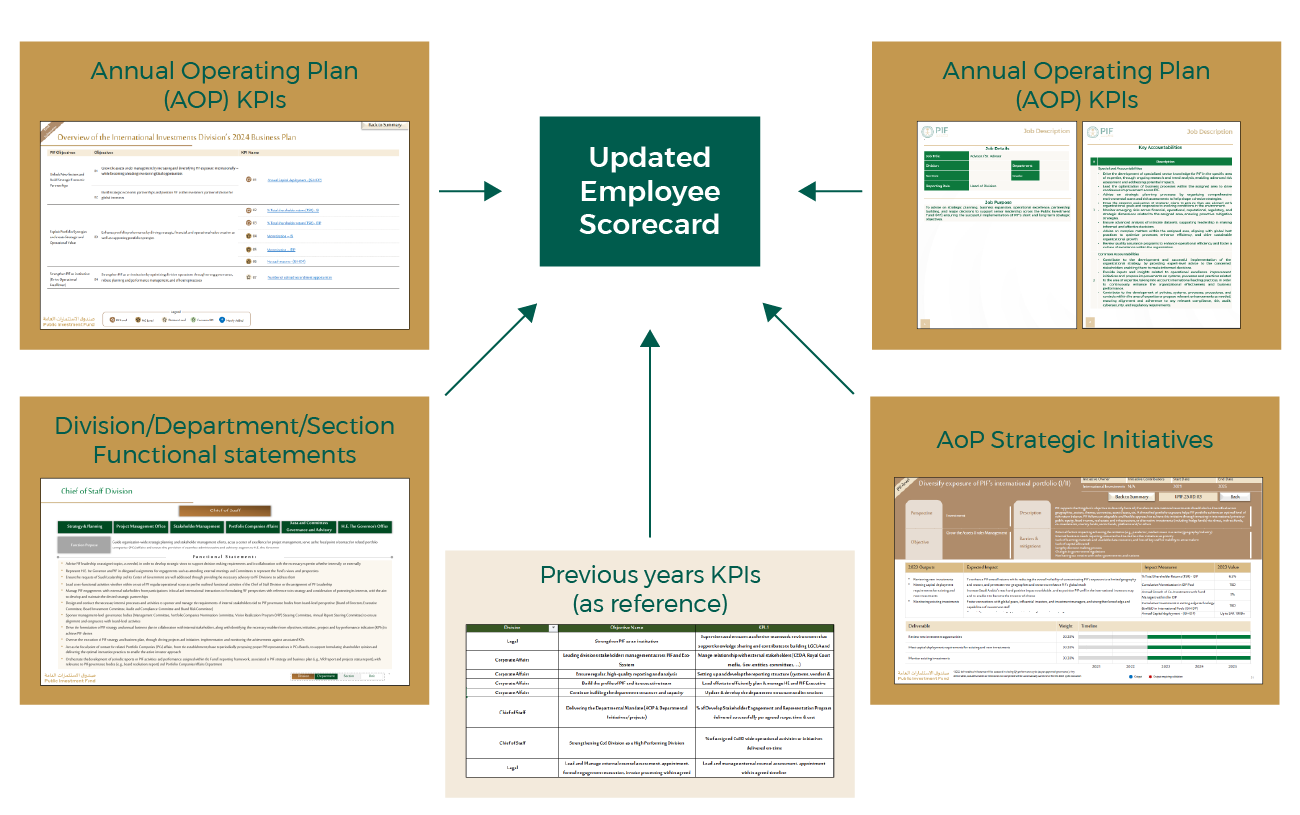
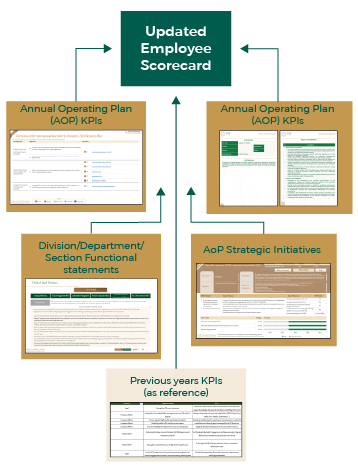
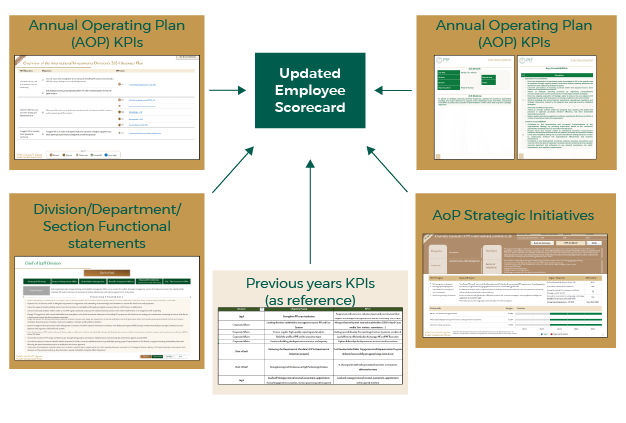
Ensuring employee scorecards are clear and comprehensive is key. To do this, we consider data from five different sources:

  • Annual Operating Plan (AOP) KPIs
  • Division/Department/Section Functional statements
  • Previous years KPIs (as reference)
  • AoP Strategic Initiatives
  • Job Description

These sources are carefully selected and curated to form the list of Objectives and KPIs within any given Scorecard.

Additionally, the Objectives and KPIs are checked to ensure they are updated and reflect the latest mandates of the employee’s role.
This is a placeholder adaptive image for the purposes of testing. This is the alt tag for this image for the purposes of testing.

KNOWLEDGE CHECK

Employee scorecards typically draw from 5 main data sources. Which of the following is not one of the data sources?

Select the option you think is correct and then select Submit.

Please use the Space key only when selecting a radio option with the keyboard. The Enter key is not fully supported. If the Enter key has been used to select a radio option, please use the Escape key. Then you will be able to use the Space key again to select a radio option.

COMING NEXT

In our next topic, we will explore the process and ownership for defining individual performance objectives. This process closely relates to the balanced scorecard framework by ensuring that individual contributions are strategically aligned with broader organizational goals.

PROCESS AND OWNERSHIP FOR DEFINING INDIVIDUAL PERFORMANCE OBJECTIVES

EMPLOYEE SCORECARD DESIGN COMPONENTS

When designing employee scorecards there are a number of areas to consider. We will go into some of these areas in more detail during this topic.

Note that typically, the HC team are able to assist with the majority of these components. However, there are two components that are best left to functional or departmental leaders due to their in-depth understanding of operational goals, and the specific responsibilities of their teams.

Select each card to find out more about the components when designing employee scorecards.

Area where HC team is able to provide input and comments

Area where HC team is able to provide input and comments

  • PIF Objective/Sub-Objective
  • KPI Level
  • KPI
  • Description
  • Measurement Methodology
  • Unit of Measurement
  • KPI Polarity
  • Data Provider
  • Target Setter

Area where HC team is NOT able to provide input and comments

Area where HC team is NOT able to provide input and comments

  • Weight
  • Target

EMPLOYEE SCORECARD DESIGN CONSIDERATIONS

Employee scorecards are designed for clarity, strategic alignment, practicality, clear ownership, and adaptability in performance tracking, while minimizing disruption to existing employee performance management practices. There are a number of considerations to be aware of when designing scorecards.

Select each item to find out more.


Strategic Alignment

KPIs at all levels should be aligned with PIF’s overarching strategic objectives to maintain coherence in goal setting and performance measurement, hence the linkage of KPIs to divisional and departmental objectives.

Clarity and Simplicity

KPIs should be clearly defined and communicated so that they are easily understood by all stakeholders. Complexity that could lead to misinterpretation or confusion should be avoided.

Number of KPIs

It is recommended that the number of core KPIs (specific to departments or sections) ideally remains in the single digits. As a litmus test, KPI holders should be able to remember most, if not all, of their KPIs at all times.

Feasibility

Ensure that the data required to measure the KPIs can be gathered accurately and efficiently, with the resources available.

Responsibility and Accountability

Assign clear ownership for each KPI to individuals at the N-1, N-2, and N-3 levels, ensuring that they have the authority and resources necessary to influence the outcome.

Adaptability

Design the scorecard system to be flexible, allowing for adjustments as organizational priorities and environments change.

TYPES OF KPIS FOR N-1, N-2 AND N-3 ROLES

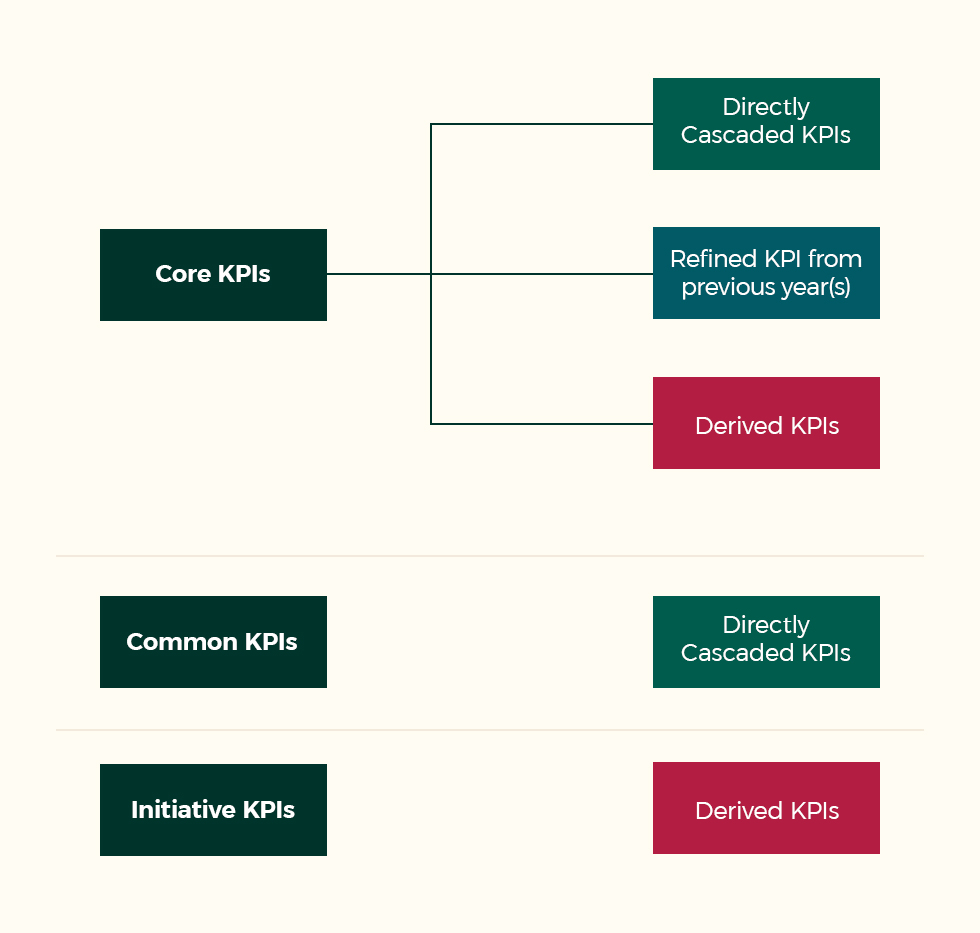
The employee scorecard for PIF roles down to the N-3 levels will be comprised of core, common and initiative KPIs. The KPI types can have different data sources resulting from direct and indirect cascading.

Select each number to learn more.

Directly Cascaded KPIs

  • KPIs that are directly linked to the objectives and targets of higher levels (N-1, N-2 and N-3)
  • Ensure alignment between different levels of the organization

go to next button

Refined KPIs from previous year(s)

  • KPIs updated and improved based on the previous year's performance and lessons learned
  • Take into account changes in the business environment, new strategic priorities and areas for improvement

go to next button

Derived KPIs

  • KPIs that are specific to each division/department/section's roles and responsibilities
  • Reflect the unique contributions and value-added activities of each division/department/section

go to next button

Directly Cascaded KPIs

  • KPIs that are directly linked to the common objectives and targets of higher levels (N-1, N-2 and N-3)
  • Applicability is determined for the relevant organizational levels (N-1, N-2, N-3, N-4 and below)

return to this button

Derived KPIs

  • KPIs that are directly linked to the initiative objectives and targets of higher levels (N-1, N-2 and N-3)
  • Initiative KPIs can be at different levels – PIF/ MC/ division level

return to this button

Image of computer screen depicting charts and graphs
1
2
3
4
5

KEY CONSIDERATIONS FOR INDIVIDUAL PERFORMANCE OBJECTIVES

Individual performance objectives are designed to promote clarity, strategic alignment, practicality, ownership and adaptability in performance tracking, while minimizing disruption to existing employee performance management practices.

Select each item to find out more about these key considerations.


Alignment

  • Objectives should be aligned with PIF’s strategic goals and the individual's role and responsibilities
  • Ensures that individual efforts contribute to the overall success of the organization
  • Promotes a sense of purpose and connection to the bigger picture

Ownership

  • Objectives should be within the individual's control and influence
  • Ensures that people are held accountable for factors they can directly impact
  • Promotes a sense of ownership and responsibility for achieving the objectives
  • Avoids demotivation and frustration caused by objectives that are beyond an individual's control

Practicality

  • The objectives should focus on outcomes that are practical and feasible to achieve and measure
  • Strengthen accountability towards the most important performance metrics
  • Ensure that the data required to measure progress can be gathered accurately and efficiently, with the resources available
  • Regular reviews and updates ensure that objectives remain relevant and aligned with PIF’s evolving needs

Collaboration

  • The objective-setting process should involve open communication and collaboration between People Managers and employees
  • Ensures clarity, alignment and commitment to the set objectives
  • Provides opportunities for feedback, guidance and support throughout the performance cycle
  • Promotes sense of shared ownership, driving positive collaboration and creating a one-world view

KEY DESIGN PRINCIPLES — SMART


Individual performance objectives should follow the SMART principle.

  • Specific
  • Measurable
  • Achievable
  • Relevant
  • Timebound

For this Human Capital SVP example, a SMART performance objective would be…

“Ensure 80% achievement of PIF talent acquisition plan by End of Q3”

KEY DESIGN PRINCIPLES — TARGETS AND WEIGHTING

The mid-year review process is a key milestone in the employee performance management cycle. During the mid-year review process, people managers provide feedback to employees on year-to-date performance, reviewing objectives and making amendments as needed.

Select each image to find out more about targets and weighting.

Targets
Weighting

Targets

The numerical target for the year (e.g., Project completion with 0% variance in budget in 2024) should be set based on historical performance, business climate, capabilities and alignment with organizational results.

go to next button

Weighting

A % factor that identifies the relative importance of the objective.

Assignment of weights should have a maximum threshold per objective at 40% and a minimum of 10%, with increments of 5% for simplicity.

go to next button

KEY DESIGN PRINCIPLES – ROLE-DEPENDENT CONSIDERATIONS

Finally, the number and weight of the objectives should vary based on the individual's role as an individual contributor or people manager.

Select each image to find out more about role-dependent considerations.

Individual Contributors
 
  • The number of objectives should be a minimum of 3 and a maximum of 6
  • Weight per objective should be a minimum of 10% and a maximum of 40% (it must sum up to 100%)
People Managers
 
  • The number of KPIs depends on the employee scorecard approved by the Line Manager for scorecard owners
  • The number of objectives should be a minimum of 4 and a maximum of 7 if a People Manager is not a scorecard owner
  • Weight per objective should be a minimum of 10% and a maximum of 40% (must sum up to 100%)

KNOWLEDGE CHECK QUESTION 1 OF 2

Complete the sentence: The employee scorecard for PIF roles down to the N-3 levels will be comprised of core, common and ________ KPIs.

Select the option you think is correct and then select Submit.

Please use the Space key only when selecting a radio option with the keyboard. The Enter key is not fully supported. If the Enter key has been used to select a radio option, please use the Escape key. Then you will be able to use the Space key again to select a radio option.

KNOWLEDGE CHECK QUESTION 2 OF 2

What is the maximum number of objectives for individual contributors?

Select the option you think is correct and then select Submit.

Please use the Space key only when selecting a radio option with the keyboard. The Enter key is not fully supported. If the Enter key has been used to select a radio option, please use the Escape key. Then you will be able to use the Space key again to select a radio option.

COMING NEXT

In our next topic, we will explore the key considerations when cascading people managers, and how to cascade KPIs from employee scorecards to individual contributors.

OBJECTIVE CASCADING CONSIDERATIONS AND SCENARIOS

KEY CONSIDERATIONS WHEN CASCADING PEOPLE MANAGER OBJECTIVES


Key considerations for direct cascading of objectives include ensuring alignment with People Managers, assessing contributor capacity, leveraging individual strengths and accounting for external conditions.

Study the table to understand the different considerations and their associated components.

Key Considerations Components
Alignment
Ensure direct contribution to People Manager KPI and relevance to job
Objective Linkage Strategic Fit Relevance to Job
Capacity
Assess workload and capability
Workload management Resource Availability Task Prioritization
Strengths and Expertise
Leverage expertise and skills
Individual Strengths Skill Utilization Professional Development
External Conditions
Set realistic and achievable targets
Market Analysis Economic Conditions Regulatory Landscape

CASCADING KPIS FROM EMPLOYEE SCORECARD TO INDIVIDUAL CONTRIBUTORS

To effectively cascade the KPIs from the KPI owners to individual contributors, we will consider various scenarios to ensure a smooth and comprehensive cascading process.

There are four approaches to cascade KPIs from the employee scorecard owners to individual contributors:

  1. Equal distribution of contribution
  2. Differentiated objectives based on strengths
  3. Functional area focus
  4. Derived objectives based on job descriptions

The first three approaches are Direct Cascading. The fourth is Indirect.

As detailed earlier, People Managers should collaborate with employees to assess whether defined objectives meet the below SMART criteria:

  • Specific: Detail what needs to be accomplished.
  • Measurable: Quantify objective with clear metrics.
  • Relevant: Align with broader business goals and the individual's role.
  • Achievable: Be realistic and attainable with given resources.
  • Time-Bound: Set a clear deadline or timeframe

Once these criteria have been considered, the KPIs will be successfully cascaded from the employee scorecard to individual contributors.

KNOWLEDGE CHECK

True or False: Setting realistic and achievable targets is a key consideration when cascading People Manager objectives/KPIs to individual objectives.

Select the option you think is correct and then select Submit.

Please use the Space key only when selecting a radio option with the keyboard. The Enter key is not fully supported. If the Enter key has been used to select a radio option, please use the Escape key. Then you will be able to use the Space key again to select a radio option.

COMING NEXT

In our final topic, we will look at our key takeaways.

SUMMARY

KEY TAKEAWAYS

Before you finish, make sure you are familiar with the key learning points of this tutorial:

  • Understand the importance of aligning individual objectives and KPIs with organizational goals.
  • Learn the process of setting SMART objectives collaboratively with People Managers.
  • Gain insights into the key considerations for cascading individual objectives.
  • Understand the linkage and cascade between Corporate Performance Management and Individual Performance Management.
  • Understand the roles of various stakeholders in setting objectives and KPIs.

CONGRATULATIONS


You have reached the end of this course. We hope you now have a good understanding of objective setting and the balanced scorecard process.

Select the X in the top right of the screen to exit the course.

HOME

WELCOME
PERFORMANCE MANAGEMENT AND STRATEGY CASCADING AT PIF
INPUT FOR EMPLOYEE SCORECARDS
PROCESS AND OWNERSHIP FOR DEFINING INDIVIDUAL PERFORMANCE OBJECTIVES
OBJECTIVE CASCADING CONSIDERATIONS AND SCENARIOS
SUMMARY

go to close menu button


go to close button