






For the Individual Contributor profile, there are two Interview Guides, one for Junior Individual Contributor and one for Senior Individual Contributor. You can access both on Citi for You. In this simulation, we are using the Senior Individual Contributor Interview Guide.



Record the rating that you feel best outlines the behaviors the candidate has demonstrated in their responses to your questions.
Use the summary section to record your recommendation and summary comments. This step will help you calibrate your observations as you consult with your recruitment partner.
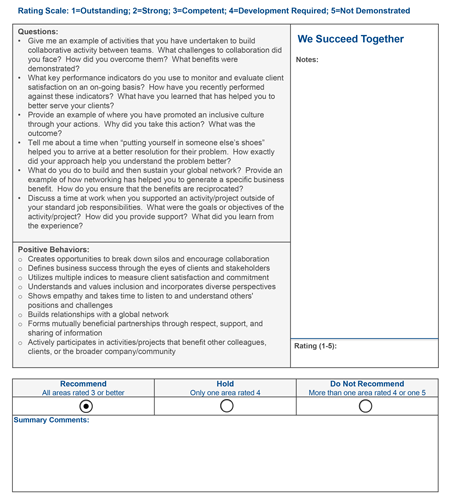

Which of these are sections on the Leadership Principles Interview Guides? Select all that apply.
That’s right.
Leadership Principles Interview Guides include the following sections:
Not quite.
Leadership Principles Interview Guides include the following sections:
Not quite.
Leadership Principles Interview Guides include the following sections:
Not quite. Please try again.

Ask the candidate about a specific situation where a competency was employed.

Ask the candidate about the task they were expected to carry out in this situation.

Find out how the task was handled.

Get the candidate to explain the effect their actions had.





Observe (listen to) everything the candidate says and ask follow-up questions where more clarity is needed. Remember, qualified candidates may have different styles and ways of communicating; recognizing individuality is just one aspect of an inclusive hiring process.
Record (write down) everything you hear in the notes section of the Interview Guide without interpreting, judging, or rating. Capture direct quotes where possible.
Classify the Leadership Principles behaviors you noted.
Evaluate all the classified behaviors and then rate according to the predefined rating scale provided within the Interview Guides.


The Citi Leadership Principles Interview Guides provide you with the questions you will need for most interviews, so you should not need to generate your own. Be sure to pre-select questions and use them consistently across candidates for a certain role. If you do generate your own questions, use them consistently across every candidate for the role.
If you need further information or detail, ask follow-up questions according to the STAR method, such as “Can you give me an example...” or “What was the outcome of...” The Interview Guides provide follow-up questions for many items; use them as needed.

Remember:
You will need to refer to the notes you have taken and then consider how they compare to the positive behaviors for each competency. Compare your notes with the positive behaviors in the Interview Guide only after the interview is complete.
Click here for more information on note-taking.

Which part of the STAR technique does the following interview question exemplify? “What steps did you take to identify the root cause?”
That’s right.
This question will prompt a candidate to explain their specific actions where a competency was employed.
Not quite. Please try again.
Not quite.
This question will prompt a candidate to explain their specific actions where a competency was employed.
Not quite. Please try again.
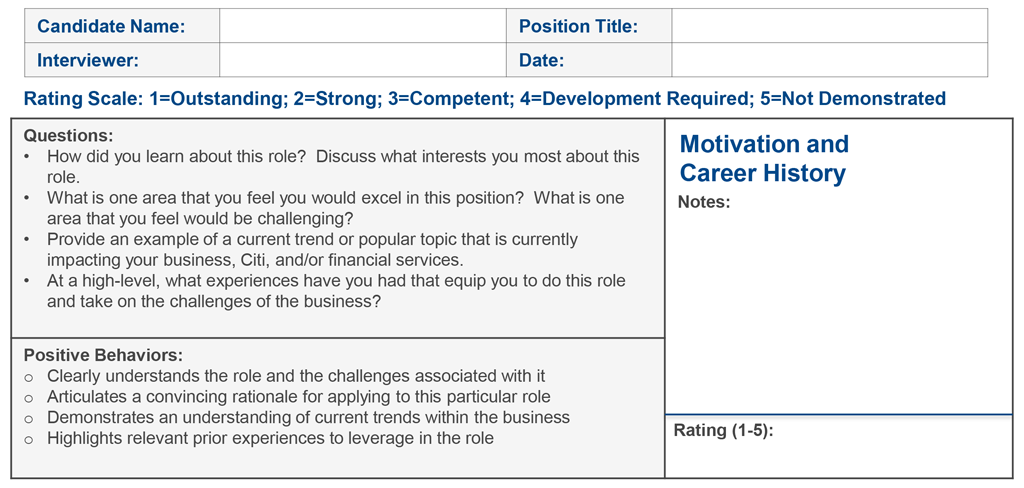
Recommend

Select the card to flip it.
All Leadership Principles are rated a 3 or better. You might be able to proceed to hire.
Hold

Select the card to flip it.
Only one Leadership Principle is rated a 4, while all other Principles are rated a 3 or better. Hold and consider additional points.
Do Not Recommend

Select the card to flip it.
Multiple Leadership Principles are rated a 4 or any one Principle is rated a 5. Do not recommend.


By providing effective feedback, you:

At Citi, we ask that our hiring managers provide feedback to each candidate they have interviewed – this can be done in-person or virtually. Either way, you'll need to clearly articulate the reasons why you hired and the reasons why you did not. This conversation supports the candidate’s growth by highlighting which skills, knowledge, and experiences are strengths and which may need development.
Find more information and tips for providing feedback in the Interview and Selection Skills Resource Guide.
Note: You may receive a request for interview feedback via Workday. These comments are important, but they will not be delivered to the candidate, so be sure to provide your direct feedback as well.



Unconscious Biases are learned perceptions, images, and stereotypes that operate automatically and involuntarily, affecting both our perceptions and behaviors. Biases stem from our natural tendency to make associations through our prior experience and stereotypes that may affect objectivity and sway our decisions.
In the busy world of work, we are more likely to stereotype and rely on biases to save time and filter information. This can become a barrier to workplace equity. Unmitigated, unconscious bias can have serious impact on the hiring process – before, during, and even after candidate interviews.








|

|
|
Diversity Drives Business and Talent Outcomes Diversity, especially in executive teams, results in better performance and can increase profitability significantly. |
Inclusive Teams Make Better Decisions Inclusive teams make more informed, well-rounded decisions and are more likely to produce innovation. |
Daniel interviewed a candidate who showed perfect competencies for the managerial role at stake. However, after discussing with his recruitment partners and hearing that their opinions were less positive, Daniel held his own thoughts back. When the time came to make a decision, Daniel cited the viewpoints of his recruitment partners and passed over the candidate. What type of bias did Daniel exhibit here?
That’s right.
Daniel exhibited Conformity bias. Rather than sharing his own perspective and using personal judgment, Daniel adopted the viewpoint of his recruitment partners.
Not quite. Please try again.
Not quite.
Daniel exhibited Conformity bias. Rather than sharing his own perspective and using personal judgment, Daniel adopted the viewpoint of his recruitment partners.
Not quite. Please try again.